Author: Markus

  • Weekly Science Picks

    Weekly Science Picks

    It is with a heavy heart that I must say, this is my final set of Weekly Science Picks here on Australian Science. In fact, it’s to be the final set of Weekly Science Picks. Unfortunately, running a site like this one is a costly affair, and it’s been an honour to be a writer here over the past year and a half. Scientific progress will, of course, always carry on and I hope there will always be places to discuss new findings, implications, and effects of it on human culture and society.

    So, proudly then, here are the final set of news stories which caught my eye this week. Make no mistake – there’s been some pretty cool news recently!


    Firstly, and in my opinion most excitingly, is a medical breakthrough which could actually revolutionise surgery in the future. And anyone who knows me will know that I don’t use words like “revolutionise” lightly. Quite simply, the device is a small pen, developed by the Australian Research Council Centre of Excellence for Electromaterials Science (ACES), which will be able to deposit stem cells and growth factors directly into injuries. This means that this pen could help injured tissue – bones, muscle, and even nerves – to regrow. Oh, and did I mention it works using 3D printing technology?

    BioPen to rewrite orthopaedic implants surgery

    The BioPen prototype was designed and built using the 3D printing equipment in the labs at the University of Wollongong and was this week handed over to clinical partners at St Vincent’s Hospital Melbourne, led by Professor Peter Choong, who will work on optimising the cell material for use in clinical trials.


    For a long time humans were considered unique in that we use tools where other animal species don’t. But since that old idea, more and more animals – from birds to octopodes – have been shown to use tools in their daily lives. The most recent addition to this collection of smart creatures is the crocodile which has been found to use lures while hunting. Perhaps this might help show that reptiles are smarter than we give them credit for!

    Alligators and Crocodiles Use Tools to Hunt, in a First

    Relatively less is known about crocodiles and alligators than many animals, because, as large predators, they are difficult to raise in the lab and study up close in the wild. Their cold-bloodedness also makes them slow. “They operate on a different time scale; they do things more slowly,” Burghardt said. “Sometimes we don’t have the patience to let them strut their stuff, as it were … so this kind of study is important.”


    A huge plume of water has been spotted, gushing from the surface of Enceladus, Saturn’s tiny snowball moon. While the exact source of Enceladus’ warmth is still something of a mystery, this sighting means that its activity is quite clear – this water plume is reaching an altitude of around 201 km above the surface of the tiny world. That’s nearly ten times as high as Olympus Mons, the solar system’s largest mountain (which itself dwarfs Everest, the heighest mountain on Earth).

    Hubble Space Telescope Sees Evidence of Water Vapor Venting off Jupiter Moon

    “By far the simplest explanation for this water vapor is that it erupted from plumes on the surface of Europa,


  • Weekly Science Picks

    Weekly Science Picks

    Well, it’s my turn to pick my favourite science news this week on Australian Science. And I must apologise for being slightly late with this. The reason is that I’ve only just got home to Tokyo after spending all week in Taipei for a conference on interstellar dust! As with any good conference, it’s been fun and fascinating but also rather tiring. If anyone’s curious to know more about what went on, the twitter hashtag #lcod2013 is where myself and others were giving internet commentary over the past week.

    Also, between talks, twitter is where I heard most of this week’s worldwide science happenings. So here are a few of the things which caught my eye…


    Firstly, Katie Mack (a long term inspiration to me) wrote an article for The Research Whisperer on the perils of the academic lifestyle and being a science nomad – and how that affects your personal life. Being still very recently relocated to Japan myself, this strikes something of a chord with me. It’s worth reading for anyone considering a science career themselves. while I personally rather enjoy the nomadic nature of this job, it’s certainly not for everyone. And I have yet to see how I feel about it a couple more years down the line…

    Academic scattering

    As for me, I confess I haven’t figured it out. I have two years left on my contract in Australia and no idea whatsoever which country I’ll end up in next. I’m applying broadly, and there’s no guarantee I’ll have a choice about location if I want to stay on the path toward becoming tenure-track faculty at a major research institution. When it’s not unusual for a single postdoc job to have 300 applicants, and faculty jobs are even more selective, getting even one offer is considered a huge win.


    Moving on to life of a different kind, a brand new species has been discovered in the waters off the coast of California. And anyone who’s been reading my articles awhile will know how exciting I find the discovery of new species! This time around, it’s a somewhat scary looking new species of crustacean. Don’t worry though. It only eats copepods.

    New Alien-like Crustacean Species Identified in California Waters

    The frail crustacean, which is only a few millimeters in length, was discovered by scientists from the University of Seville in Spain and the Museum of Natural History in Canada, who had published a taxonomic description of the new species in the journal Zootaxa.


    Meanwhile in space… When people talk of space stations and lasers, a lot of us will immediately think of Star Wars. Or whatever other sci fi we might prefer. However, up in orbit around Earth, our own space station is preparing to use lasers for a rather less destructive purpose – to transmit video back to use down here on the ground.

    Pew! Pew! Laser On The Space Station Will Beam Video To Earth

    “Optical communications (also referred to as ‘lasercomm’) is an emerging technology wherein data is modulated onto laser beams, which offers the promise of much higher data rates than what is achievable with radio-frequency (RF) transmissions.

  • Weekly Science Picks

    Weekly Science Picks

    I’m loath to begin a weekly roundup on a low note, and I’m truly sorry to have to, but this most certainly needs to be discussed. It’s been a turbulent week this week in the science blogging world. Turbulent and full of raised concerns over the state of things for those in a science communication career. Basically, there have been two sexual harassment scandals in the news – the first concerning Urban Scientist Danielle Lee and her terrible treatment by an editor at biology online, and the second around playwright and author Monica Byrne and some downright shameful behaviour on the part of Bora Zivkovic, blogs editor at Scientific American.

    Both women, after being given rather distasteful treatment, decided to go public with the matter. This has rightfully sparked some quite heated discussions across the online science writing community. The entire matter is summarised quite well by Priya Shetty at the Huffington Post and Laura Helmuth at Slate. I’d recommend reading Dr Isis’ perspective on all of this too. My personal opinion is that the behaviour of “Ofek” at biology online (who has been fired since the incident in question) and of Zivkovic (who has since resigned from the board of directors and Science Online) is an utter disgrace and humiliation to all of us involved in the science communication community. While it’s reassuring to know that neither of these recent events has occurred without repercussions, it raises the huge concern of precisely how often events like these occur and simply go unreported.

    I feel it’s of prime importance to all of us to show our support to Lee and Byrne, not only for their sake but for the sake of all others out there who’ve been similarly marginalised. They need to know that they have our support and that we will listen if they choose to make the remarkably difficult decision to speak out about experiences like these. That is, after all, what a community is all about. Personally, I’d like all of online scicomms to be an open and welcoming forum for discussion of all kinds. I’m not sure if I feel it can be, knowing that things like this are occurring beneath the surface, but I truly hope that such nasty incidents can someday be a thing of the past.

    Now… Scandals aside, there have also been some rather remarkable happenings this week in science.

    Perhaps most remarkable is the news that amputees may be able to have their sense of touch restored with technology. Much like Luke Skywalker in The Return of the Jedi, people left disabled due to amputations may soon be able to not only control prosthetic limbs directly with their brains, but also feel them. Needless to say, the implications of this are just wonderful!

    Prosthetic wired to the brain could help amputees feel touch

    In my lab at the University of Chicago, we’re working to better understand how the sensory nervous system captures information about the surface, shape and texture of objects and conveys it to the brain. Our latest research creates a blueprint for building touch-sensitive prosthetic limbs that one day could convey real-time sensory information to amputees and tetraplegics via a direct interface with the brain.


    Recognising threats is a vital skill in the natural world, and has been a mainstay of evolution in animals since the Precambrian era. And some creatures have evidently gone to great lengths. Latest research shows that the rainbowfish, a fairly humble seeming species, can smell predators when they’re still embryos, a mere 4 days after fertilisation!

    The nose knows: Rainbowfish embryos ‘sniff out’ predators

    Jennifer Kelley, a scientist with the University of Western Australia, explains that predator recognition is required at such an early age because responding to predator cues is absolutely crucial for early survival. For example, detection of “alarm cues” suggests that other fish in the vicinity have been attacked by predators.


    Seeming like something taken straight out of Michael Crichton’s Jurassic Park, blood has been discovered inside a fossilised mosquito for the first time ever. While most likely not from a dinosaur, it’s fascinating to finally have concrete proof of such an audacious science fiction concept.

    First Blood-Filled Mosquito Fossil Makes Jurassic Park Feel More Real

    Even if it doesn’t bring us closer to getting an amusement park of death and delight, this is a pretty exciting discovery. We never knew that blood could last so long inside of a mosquito! What other kinds of surprises are hiding underneath Montana?


    And finally, as an avid Instagram user myself, I find it rather interesting that a study has found that photographing your dinner can actually make the meal less enjoyable. While this doesn’t look to be a particularly big study, it exposes an interesting little facet of human psychology. And for the record, no, I don’t normally Instagram my food. Though I know a few people who do.

    New research shows how ‘Instagramming’ a meal can ruin your appetite

    Basically, when we look at photos of say, fish and chips over and over before we eat it, our senses become ‘bored’. The photos ruin your appetite by making you feel like you’ve already experienced eating the fish and chips before… This sensation is measured in levels of satiation, a scientific term for the ‘drop in enjoyment with repeated consumption’. Consumption, in this case can just be viewing a photo of food, not actually eating a food.


    And finally, let’s end with something pretty. For some gorgeous botanical images, Botanartist is a brand new blog full of some really rather charming photographs of plants, both close up and extremely close up through a microscope. If you want to enjoy some cool macro photography and scientific explanations of what you’re seeing, you’ll probably find all of this just as marvellous as I do!

    I hope everyone has a great week. Until next time, DFTBA and stay curious!

  • Weekly Science Picks

    Weekly Science Picks

    Hello everyone. I hope you’ve all had a good week! It’s a balmy Autumn evening here in the UK where I sit as I write this – and I must say, this week’s science picks include something quite historic…

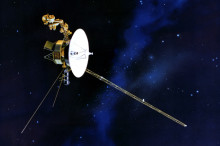
    Anyone with half an eye on the science news recently should know by now that it’s been officially confirmed that NASA’s Voyager 1 probe is has now been confirmed as being in interstellar space. It is no longer within the Sun’s heliosphere and no longer feels the solar wind. To Voyager, the Sun is now simply another star in the sky. Though as Phil Plait points out, being in interstellar space is not technically the same thing as leaving the solar system.

    Voyager 1 Reaches Interstellar Space. But Has It Left the Solar System? Wellllll…

    However, there’s more to our solar system’s far-flung suburbs than errant electrons and protons. Even out there, over 120 times farther from the Sun than the Earth’s orbit, there are more substantive objects: huge, frozen chunks of ice that are essentially giant comets… It’s like walking outside the front door of your house and saying you’ve left your property. While you’ve left your house, there’s still the yard all around you. You have a ways to go yet.


    Citizen Science has been around for a while now, as a fun and interesting way of getting internet users to casually help scientists analyse vast amounts of data. So the latest idea is to use online gaming and social media platforms like Facebook to bolster the effort…

    How Facebook and gaming could help scientists battle disease

    One example, a smartphone game set for release later this year, is currently called “GeneGame”. Players of the game, developed by Cancer Research UK, will be contributing to the identification of cancer-causing genetic faults from tumour samples. In a crucial difference to the Galaxy Zoo experiment, the scientific research will be a indirect consequence of the gameplay, rather than the explicit focus of the gameplay.


    From a long departed craft, to one of the most recent, NASA’s LADEE vehicle is currently en route to the Moon, to study its tenuous atmosphere (and the word “Atmosphere” is used rather loosely here, believe me). But as the probe was launched, there was an unfortunate amphibian casualty. You see, the launch pads at NASA’s Wallops facility are built in rather swampy areas…

    Frank the Frog Sacrificed Himself for LADEE Launch

    From NASA: “A still camera on a sound trigger captured this intriguing photo of an airborne frog as NASA’s LADEE spacecraft lifts off from Pad 0B at Wallops Flight Facility in Virginia. The photo team confirms the frog is real and was captured in a single frame by one of the remote cameras used to photograph the launch. The condition of the frog, however, is uncertain.

  • Weekly Science Picks

    Weekly Science Picks

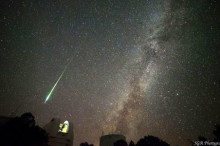
    After the Perseid meteor shower last weekend, it seems that lots of exciting things have been discussed this week. Here are a few of the things which caught my eye.


    The first of my picks is homegrown here on Australian Science, if you’ll pardon the pun. A sustainable food source for space travellers and outposts is one which has a lot of scientists and engineers scratching their chins, as does dealing with waste products. Which makes the prospect of using a form of bacteria to recycle waste and generate a food supply a very interesting one…

    Red bacteria as astronaut food

    Bacteria offer an attractive ingredient for space food. Quick and easy to grow, exponentially and to large numbers, and can provide the basic nutrients. And it was in search for astronaut space food that another discovery was made.


    There’s been a lot of talk this week about the Hyperloop – a high speed transit system conceived by everyone’s favourite space entrepreneur, Elon Musk. I must say, the concept looks quite exciting.

    Hyperloop

    The design of Hyperloop has been considered from the start with safety in  mind. Unlike other modes of transport, Hyperloop is a single system that  incorporates the vehicle, propulsion system, energy management, timing, and  route. Capsules travel in a carefully controlled and maintained tube  environment making the system is immune to wind, ice, fog, and rain. The  propulsion system is integrated into the tube and can only accelerate the  capsule to speeds that are safe in each section. With human control error and  unpredictable weather removed from the system, very few safety concerns  remain.


    Poor Voyager 1. For a startlingly long time now, we’ve been unsure about whether or not it’s actually left the Solar System and the protective influence of the Sun’s solar wind. In fairness, this is because it’s truly an explorer and, in a manner which would make any Star Trek fan proud, going where no one has gone before. All the same, the most recent buzz is that Voyager 1 may have indeed left the Solar System. In fact, it looks like it did so last year. (Though this study will no doubt remain contentious, there are a few of us who suspected this was the case).

    Voyager 1 Spacecraft Left Solar System Last Year, Study Suggests

    “It’s a somewhat controversial view, but we think Voyager has finally left the solar system, and is truly beginning its travels through the Milky Way,” lead author Marc Swisdak of the University of Maryland said in a statement.


    Interestingly though, some recent archaeological discoveries suggest that, despite the achievements of human technology, the first technology wasn’t created by modern humans at all. The exact nature of our extinct cousins, the neandertals, is shrouded in mystery, but it looks as though the first specialised bone tools ever created on Earth were made by them, and not us homo sapiens.

    Neandertals Made the First Specialized Bone Tools in Europe

    How widespread this new Neandertal behavior was is a question that remains. The first three found were fragments less than a few centimeters long and might not have been recognized without experience working with later period bone tools. It is not something normally looked for in this time period. “However, when you put these small fragments together and compare them with finds from later sites, the pattern in them is clear,” comments Shannon McPherron. “Then last summer we found a larger, more complete tool that is unmistakably a lissoir like those we find in later, modern human sites or even in leather workshops today.”


    I hope everyone has a good week!


    Image: A luminous Perseid meteor over the McDonald Observatory, Texas. Credit and copyright: Sergio Garcia Rill/SGR Photography.

  • Weekly Science Picks

    Weekly Science Picks

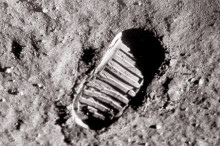
    I hope everyone’s enjoying a nice weekend! It’s my turn again for the weekly science picks, and this week is the 44th anniversary of the Apollo 11 moon landing. On July 20th 44 years ago, human beings took their first small steps onto the surface of an object in the solar system other than the Earth. While we may not have returned to the Moon since NASA’s Apollo program, it’s important to realise the leaps and bounds which human technology and scientific knowledge have made since then.

    And speaking of those leaps and bounds…

    Astronomers have managed to determine the colour an exoplanet would appear if were able to see it with our own eyes. Planet HD 189733b, one of the most well studied worlds out there in our galaxy, is a beautiful azure blue planet. But don’t let the similarity to our own planet’s colour fool you. The blue colour of HD 189733b is because it’s a hot jupiter, orbiting scorchingly close to its parent star, and that colour is because the rain on this world is made of glass!

    Exoplanet HD 189733b Appears to be Azure Blue

    “This planet has been studied well in the past, both by ourselves and other teams,

  • Pacific plant could be good news for anxiety sufferers

    Pacific plant could be good news for anxiety sufferers

    A clinical study on kava, a Pacific plant, has found that it has properties which could be extremely useful in treating the symptoms of anxiety. The plant has been used recreationally in Pacific societies, in places like Polynesia and Hawaii, for a long time but this is apparently the first proper clinical study of the plant.

    Now, I must admit, I’m writing this story because I have some anecdotal experience with kava (piper methysticum) myself. Simply, I’ve been an insomniac on and off for most of my adult life. It can be an inconvenience, but I mostly have it under control. Of course, I’ve tried numerous different things to ease the insomnia, with varying degrees of success – but kava was always one of the best. That is, before it became unavailable to buy here in the UK.

    This latest study, led by researchers at the University of Melbourne certainly seems to support the plant’s apparent calming ability. It may prove to be very useful to the significant numbers of people, both in Australia and worldwide, who suffer from anxiety disorders.

    Anxiety is a more common problem than many people may think. In particular, generalised anxiety disorder (GAD) is a blight to millions of people around the world; in Australia, 3% of people suffer from GAD, and the numbers are similar in North America and parts of Europe, with estimates in the UK being as high as one in 20. Over the past decade, I’ve known a huge number of people who suffer from anxiety, and unfortunately, treatments for this type of disorders are far from straightforward.

    “Based on previous work we have recognised that plant based medicines may be a viable treatment for patients with chronic anxiety,” explained lead researcher Jerome Sarris at the University of Melbourne’s Department of Psychiatry, who believes that new an more effective options are needed for patients with anxiety, instead of the existing medications. Sarris stressed the complexity of GAD and the way it can significantly affect the daily lives of those who suffer from it, continuing to add that, “In this study we’ve been able to show that Kava offers a potential natural alternative for the treatment of chronic clinical anxiety. Unlike some other options it has less risk of dependency and less potential for side effects.

  • Explosions visible from across the Universe

    Explosions visible from across the Universe

    Gamma ray bursts are the most violent and energetic events in the entire universe. Powerful blasts of high energy gamma radiation, bright enough to be seen from literally the very edge of the visible Universe. And yet, we know surprisingly little about them. Of course, we have theories, but every now and again astronomers spot something which those theories don’t fully cover. Such as a couple of years ago, when an international team of astronomers caught a glimpse of the longest lasting gamma ray burst ever seen.

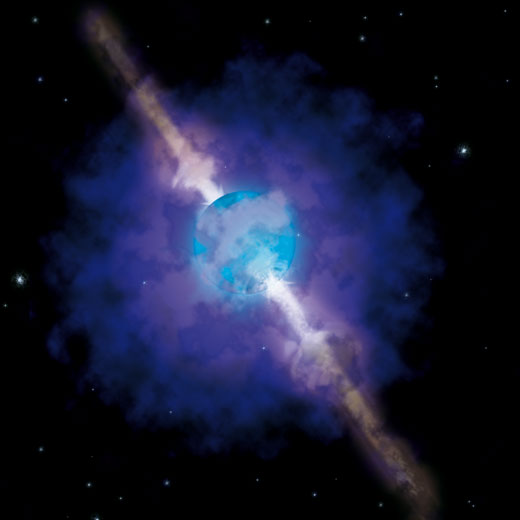
    December 9th, 2011. NASA’s Swift telescope detected a sudden spike of gamma rays from somewhere within the constellation of Phoenix, visible in the Southern hemisphere. Gamma ray bursts (GRBs for short) like these are normally subdivided into two types, short bursts and long bursts, which have different causes. Short bursts last for just a couple of seconds, while long bursts can last for several minutes. But this particular burst, dubbed GRB 111209A (pictured above), was very different. One of a unique, rare breed of extra long lived GRBs, and by far the longest ever observed – lasting an unprecedented 7 hours!

    Ever since then, astronomers have been picking at the data which were recorded, trying to work out exactly what kind of unusual circumstances would cause such a goliath GRB. One team, a collaboration between Bruce Gendre now at the French National Center for Scientific Research, and David Coward and Eric Howell at the University of Western Australia, managed to get to what may be the bottom of the puzzle. In short, these extra long GRBs are caused by the deaths of the Universe’s most massive stars.

    It’s a sobering fact that all stars die. Some burn slowly for billions of years. The very smallest may burn for trillions. But the most massive stars burn out rapidly before dying in titanic explosions which we know as supernovae. It seems that the most massive of the massive, exceptionally rare, die in a unique type of GRB.

    So far, only three of these ultra-long GRBs have been found, appearing so bright that some astronomers initially believed that they came from inside our own galaxy. As it happens, this wasn’t the case. Analysing GRB 111209A, Gendre and his colleagues hypothesised the source of it to be an extremely hot, massive star.

    A furiously burning blue supergiant (possibly a hypergiant), hundreds of times the diameter of the Sun. When a star like this dies, its core collapses into a black hole, which then proceeds to start devouring the star from the inside out. As that black hole hungrily eats, its mammoth gravitational forces brutally tearing matter apart at the subatomic level, it generates an immense amount of energy which causes two jets of material to shoot out from its north and south poles. These are blasted outwards out with such ferocity that they actually punch two holes in the doomed star.

    Read that again. A star which is hundred of times as massive as the sun, and these jets are powerful enough to blast two holes in it! The amount of energy required to accomplish that is truly difficult to comprehend.

    Oh em GRB!

    The stars which die in these titanic events still require a specific set of circumstances. These stars are apparently enriched in elements heavier than helium (astronomers refer to these as “metals”, even though chemists would disagree on a few counts). More of these heavier elements cause a star’s stellar wind to increase, causing its rotation speed to slow as it loses material. But faster spinning stars seem to be more likely to cause these long bursts, which led some to wonder if the massive star behind GRB 111209A was also cannibalising another nearby star – a process which could possibly cause its rotation to speed up.

    The exact cause is still a matter of puzzles and hypotheses. We won’t know more until we observe more of these ultra-long GRBs, and seeing as we’ve only ever spotted 3 of them, it may remain a puzzle for a while yet. But a tantalising glimpse like this of one of the Universe’s most extreme events gives us a good reason to keep watching and waiting. When we do finally understand, it will almost certainly have been worth waiting for.

    Image credits:
    Top – NASA/Swift/B. Gendre (ASDC/INAF-OAR/ARTEMIS)
    Bottom – CNRS/ARTEMIS – Céline Lavalade

  • Printed solar cells as easy to produce as t-shirts!

    Printed solar cells as easy to produce as t-shirts!

    Australia is really taking the initiative in alternative energy production. The latest news is that a consortium of Australian researchers have succeeded in producing printable solar cells, in a process which might just have the potential to revolutionise solar power production across the continent. Perhaps, we can only hope, the world.

    Succinctly, a new printer which has been installed at CSIRO is capable of printing solar cells the size of A3 sheets of paper – the largest ever created. Printing onto sheets of flexible plastic, it can produce these at a rate of 10 metres per minute (one new and fully functioning solar cell every 2 seconds!), and those cells can produce between 10-50 Watts per square metre, dependent upon how much light they receive. Oh, and the best part? The printer uses no brand new or special technology. In fact, it’s not a lot different to mass producing printed t-shirts!

    The group responsible refer to themselves as the Victorian Organic Solar Cell Consortium (VICOSC), and they’re made up of a collaboration between CSIRO, The University of Melbourne, and Monash University, together with a handful of industry partners. Over the past 3 years, they’ve been working on printing solar panels. Starting with a cell the size of a human thumbnail, they’ve scaled their way up to larger and larger sizes. And they have plans. Big plans.

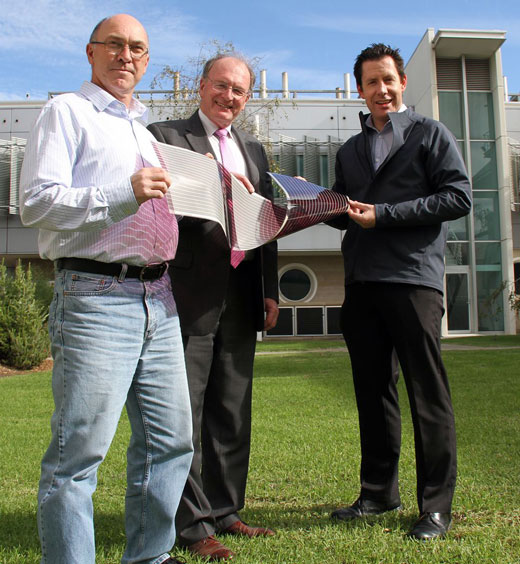
    Dr David Jones, Professor Andrew Holmes and Dr Scott Watkins, three of the researchers involved, together with one of their printed solar cells.
    Dr David Jones, Professor Andrew Holmes and Dr Scott Watkins, three of the researchers involved, together with one of their printed solar cells.

    I mentioned a little while ago in my article about wind power, that I’m a keen advocate of alternative energy. This is because, and let’s be frank here, energy based on crude oil is not sustainable in the long term. I could list dozens of reasons why this is the case, not least of which is the fact that oil reserves are limited. But the biggest factor is pollution. We really need to start taking better care of this world.

    Australia, it has to be said, receives one thing in abundance. Sunlight. Developing solar power seems like something of a no brainer, especially for more isolated areas. In fact though, the Earth receives a staggering amount of solar energy constantly.

    Sunlight hitting Earth carries with it approximately 174 petawatts (174,000,000,000,000,000 watts!) of power. Of course, for the most part we’ll never be able to harvest it. Around 30% is immediately reflected back into space (which is good, because otherwise our planet would boil). But if we could harvest just 0.01% of the solar energy hitting our planet, we would have more power than the entirety of human civilisation can currently use!

    Realistically, powering everything on our world with solar power may not be feasible. But a significant fraction of global energy needs could be easily met with solar power – particularly in areas which receive a lot of sunlight. Areas like much of Australia. The new techniques developed by VICOSC could make solar energy much more accessible to the world at large.

    Firstly, the printing techniques they use are familiar to us all. Essentially, it’s much the same as screen printing – except that they use semiconductive inks which can be printed onto either flexible plastic or steel, dependent on where precisely they’re needed. Even better, the group are currently researching new non-chorinated solvents to use, making the entire operation even more environmentally sound!

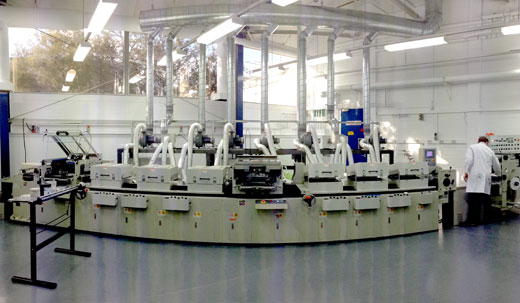
    The newly installed solar cell printer at CSIRO.
    The newly installed solar cell printer at CSIRO.

    While the new printer at CSIRO to produce these solar cells cost a total of A$200,000, the future component costs are tiny. These printed energy collectors work out at a price of just A$1 per watt! Needless to say, this is a huge improvement over any solar panels the market can currently offer.

    The group suggest a couple of particularly interesting uses for their printed solar cells. For a start, they can actually be used to improve the efficiency of existing solar cells. The two technologies absorb sunlight at different wavelengths. This means that the same area of solar cell could be able to effectively collect twice the power.

    Even more dramatically, there are plans to further scale up the printing equipment they’ve used (because why not, right?) and create much larger cells. These could be laminated onto the windows of large buildings like skyscrapers, making any city into its own power plant. Effectively a single typical skyscraper (for example, the Century Tower in Sydney) could “generate” over 100 kilowatts of power just by standing there.

    The new printed solar cells aren’t quite ready to be released to the public just yet. But it sounds like they might be soon. Currently, they’re still undergoing tests. To date, they have a theoretical maximum power of 80 watts per square metre, and the cells currently being produced have a lifetime of over 6 months.

    The current goal is to raise their useable lifetime to 2 years. But of course, given how ambitious VICOSC have been so far, I doubt they’ll stop there. Maybe we should start thinking about taking the word “alternative” out of “alternative energy”.

    Image credits: CSIRO/VICOSC

  • Weekly Science Picks

    Weekly Science Picks

    I hope everyone’s had a good week! Personally, mine’s been rather tiring, having to take care of various academic shenanigans and with plenty to write about. And I have a couple of research fellowships still to apply for. Eek! But enough about me, because there have been some genuinely exciting things happening in science over the past few days. Here are the stories which managed to catch my eye…


    One of the most interesting pieces of science news this week was that, for the first time ever, a fluorescent protein was discovered in a vertebrate animal – specifically, the Japanese freshwater eel. I also like that the protein has been named unaG – 鰻, or “unagi” is the Japanese word for eel!

    First fluorescent protein identified in a vertebrate

    “I don’t think anyone would have thought that eels would have such a bright fluorescent protein,

  • Neutron star glitch needs new theories to explain it

    Neutron star glitch needs new theories to explain it

    Neutron stars are some of the strangest and least understood objects in the entire Universe. Over 1.5 times the mass of our whole solar system, squeezed into an object comparable in size with a city, these curious objects wield titanic gravitational fields and, often, immense magnetic fields. They’re also so incredibly dense that it’s difficult to fully appreciate* And sometimes, for reasons we don’t fully understand, their rotational speed suddenly changes.

    These sudden changes in rotation are known as glitches, and they happen to a particular, rare type of neutron star, known as a magnetar – a neutron star with an exceptionally strong magnetic field, which occasionally undergoes violent outbursts known as starquakes. These starquakes have been known to cause the rotation speed of a neutron star to suddenly increase. But one of these oddities is an oddity among oddities. A magnetar known as 1E 2259+586 was recently observed not to speed up, but to slow down. The reason? No one knows.

    The team in charge of this work, led by Victoria Kaspi at McGill University, Montreal, summed up their observation in a press release by saying that it “constitute[s] a new theoretical challenge.” Now, to someone like me, this is very exciting. Specifically because this means that, working with existing theories, they don’t know what’s going on. It’s currently unexplainable. And when this sort of thing happens, it means we’ve discovered something which we didn’t know before.

    Any good scientist should be thrilled when they don’t understand something, because this means that there’s something new to understand. In this particular case, the fact that this magnetar seems to have done the opposite of what it should has managed to throw a spanner in the works**.

    1E 2259+586
    An x-ray image of the neutron star 1E 2259 586 in false colour. Low energy x-rays are shown in red, medium energy in green, and high in blue. Credit: ESA/XMM-Newton/M. Sasaki et al.

    “Astronomers have witnessed hundreds of events, called glitches, associated with sudden increases in the spin of neutron stars, but this sudden spin-down caught us off guard,” Kaspi explained. Indeed, the regular type of glitch is, we think, quite well understood.

    What precisely might be found beneath the ultra hard crust of a neutron star is a mystery. We might perhaps never be able to directly observe it and find out (neutron stars aren’t fond of guests, and have a tendency to turn anything which lands on them into a large thermonuclear explosion). But what we can deduce is that the interior of a neutron star is a kind of superfluid, composed mostly of neutrons. At the surface of a neutron star, high energy particles are accelerated outwards. This is known as a pulsar wind, and it’s the main mechanism through which neutron stars cool.

    As this pulsar wind carries away energy, it gradually grains energy and momentum from the surface of the neutron star. But this causes stress to build up under the surface. After enough stress builds up, the crust ruptures with an almighty crack. This causes the star to emit a huge burst of x-rays. It also allows the crust to catch up with the rotation speed of the interior. Neutron stars slow down when they’re ready to and not a moment sooner.

    The neutron star in question, 2259+586, lies around 10,000 light years away in the constellation of Cassiopaeia and rotates once every 7 seconds or so. In the x-ray image shown above, it’s quite obvious in high energy x-rays (coloured blue in the image). The lower energy x-rays show a pulsar wind nebula as those high energy particles streaming away from it crash headlong into the surrounding interstellar medium.

    Crust fractures in neutron stars sometimes go by the name of starquakes, and they can be caused by tangled up magnetic field lines too. But it’s this particular mechanism which causes these stars to glitch. 2259+586, however, is going against the grain. Because it’s been observed to do the opposite of what it should, this previously unknown phenomenon has been dubbed an ‘anti-glitch’. What’s more, not content with its abrupt slowdown, 2259+586 is also slowing its speed faster than it was previously observed to (an effect known as “spinning down”).

    Sometime in late April, before the anti-glitch was discovered, the Fermi space telescope picked up a powerful x-ray burst. Lasting just 36 milliseconds, the researchers believe that it was this burst which signalled the magnetar’s unprecedented drop in rotational speed. Robert Archibald, the lead author on the paper published on this work, explained, “What is really remarkable about this event is the combination of the magnetar’s abrupt slowdown, the X-ray outburst, and the fact we now observe the star spinning down at a faster rate than before.”

    As for why this has happened? Well, now we need to wait for the theoreticians to solve the puzzle. And, at least for some of us, that’s the fun part!

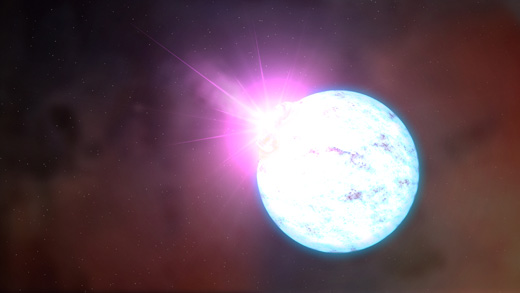
    Beautiful but deadly
    Artist’s impression of a starquake on a magnetar’s surface. Credit: NASA Goddard

    * As one tumblr user so wonderfully described it, “an average printed period, if it were as dense as a neutron star, would weigh about as much as a train car FILLED WITH BRICKS.”

    ** A star mangled spanner, perhaps?

  • What do Mars and Australia have in common?

    What do Mars and Australia have in common?

    If you’re expecting a punchline to that title, then guess again. It’s no joke. Surprisingly, Australia shares some remarkably similar geology to our neighbouring planet. Specifically the Red Centre, the arid heart of Australia, is the most Mars-like place on Earth!

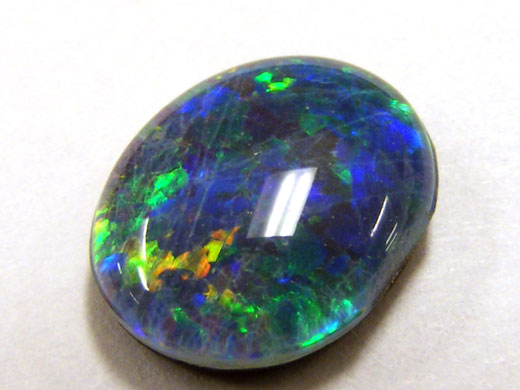
    It’s possible that people may have mused on the similarities already. After all, with its strikingly rich colours, the Red Centre (more often known as the Outback) certainly looks like few other places on Earth. Without any vegetation, the colour of the soil and rocks in the region could easily resemble Mars in places. But evidently, this resemblance is more than just skin deep. The clue that lead to this fascinating realisation? Another of Australia’s most beautiful and iconic of things – opals.

    Uluru view!
    A view from the top of Uluru, showing it’s distinctive red colour. Credit: Binarysequence/Wikimedia Commons

    Patrice Rey at the University of Sydney’s School of Geosciences was investigating how opals formed. It may be surprising to learn that opals are found in few other places on Earth, with roughly 90% of all opals worldwide having originated in Australian mines. Beautiful and sought after, there’s been a lot of mystery behind opals for a long time – specifically about how they form, why they’re found at such shallow depths under the Australian soil, and why they’re found nearly nowhere else on Earth.

    The story of these beautiful sparkly gemstones, it turns out, began around 100 million years ago. At the time, most of central Australia was covered by the Eromanga Sea. In times past, this huge epicontinental (inland) sea covered what is now known as the Eromanga Basin – spanning an area of one million square kilometres and reaching into much of what is now Queensland, the Northern territories, South Australia and New South Wales.

    During the Cretaceous period, when dinosaurs still ruled our planet, this sea would have been teeming with prehistoric life. But much like the dinosaurs, the Eromanga Sea was doomed. Around 100 million years ago, the climate of Earth began to change and the sea began to dry out. The sea dried out rapidly on geological timescales, to cover a much smaller area. The result was that the chemistry of the surrounding rocks began to change.

    As the Eromanga Sea dried out, pyrite minerals in the surrounding rocks began to release sulfuric acid, causing acid weathering on a huge scale – quite possibly the largest Earth has ever seen. The opaline silica which was created in the Australian rocks during this process would later go on to form into opals. But the big clue is the acid weathering – we only know of one other place in the Solar System where this has happened in the past. Planet Mars.

    While the predicament of prehistoric Australia is, as far as we know, unique on Earth, Mars actually shares a lot in common with this event. Except on Mars, we believe that the drying out of seas happened on a global scale. Hints of this were detected in 2008, when NASA’s twin Mars rovers, Spirit and Opportunity, detected several telltale clues in the Martian soil.

    The surface of Mars was found to hold opaline silica, iron oxides, and certain types of clay. All of these clues led areologists* to conclude that the surface of Mars had been subject to huge amounts of acid weathering. The exact same type of acid weathering which Rey and his fellow researchers have now discovered to have happened in Australia!

    An opal doublet from Andamooka, South Australia.
    An opal doublet from Andamooka, South Australia. Credit: CRPeters/Wikimedia Commons

    If you’re thinking that this means that there may be Martian opals waiting to be discovered somewhere on the planet next door, it’s hard to say. But it’s certainly a possibility! There is, however, one final step in the formation of opals. The opaline silica which was found on Mars is not yet true opal. In Australia, the surrounding rock has an impressive capability to neutralise acid. This means that after the ground in Australia became riddled with opaline silica, the surrounding conditions quickly went from acid to alkaline. When this happens before the silica trapped in rock cavities dehydrates and solidifies – voila! Opals! Of course, there’s a good chance that Mars may be home to some kinds of rock which can also neutralise acid the same way.

    So only time will tell. Perhaps someday in the future, Martian colonists may be using Mars opals to create the first ever jewellery made elsewhere in the Solar System!

    *An areologist studies the geology of Mars, seeing as technically the “geo” in geology refers to planet Earth.

    Could there be opals hiding under the Martian soil?
    Could there be opals hiding under the Martian soil? Credit: NASA/JPL


  • Wind power: renewable energy for the cities of the future

    Wind power: renewable energy for the cities of the future

    Renewable energy? I’m a big fan! Unfortunately, so are modern wind turbines, which are the subject of intense arguments and criticism despite their many benefits. However, this view might be changed somewhat, by a new innovation by Farzad Safaei at the University of Wollongong (UOW) – a new type of wind turbine known as PowerWINDows.

    I’m actually going to come straight out and drop the neutral viewpoint on this article, because this is important. I am very much a supporter of renewable energy, and I find it quite preposterous that anyone would even think about arguing against it. Very recently, carbon dioxide levels in the atmosphere have reached 400 parts per million for the first time in recorded history. This may not seem like a lot, but Earth’s atmosphere hasn’t seen this much carbon dioxide for over 3 million years. It may sound like a cliché to say, but by continuing to burn fossil fuels we’re doing some permanent damage to our planet. And speaking as an astronomer, I can say with some authority – this is the only planet we’ve got.

    Lots of people argue against wind turbines. In my not-so-humble opinion, this is ridiculous. Nonetheless, it happens. People claim that they’re “a blight on the landscape”, that they generate noise, that they affect local wildlife, and that they have a negative impact on health. Most of these criticisms are unsubstantiated and have no basis in fact. Let’s think rationally here: all of the same things are probably true of any other form of power station. And when other power stations go wrong, the effects can be significantly worse than a broken propeller blade. Hopefully then, innovations like PowerWINDows might help to both silence the critics and make wind energy a more easily attainable power source.

    Just imagine how much power the Petronas towers could generate...

    The basic idea with PowerWINDows is that there are none of the large rotating blades which people claim to be dangerous. The smaller, compact design allows PowerWINDows turbines to be installed on tall buildings such as skyscrapers and apartment blocks. All in all, the newly designed turbines are cheaper, quieter, and more convenient than existing wind turbine technology.

    After four years of design and testing work, UOW have signed a deal with Birdon, one of Australia’s top engineering companies, to build and test a prototype suitable for commercial production. If all goes according to plan, the new turbines may go into production sometime in the future. Just imagine how much additional power could be generated if every large city had wind turbines installed on every tall building!

    Professor Safaei’s inspiration for the idea was a desire to improve on existing wind turbines and any of their shortcomings – i.e. the criticisms made against them. His goal was to enable modular manufacturing, reduce noise and land usage, and allow easier transportation and installation. “I wanted to create a wind turbine that better integrated with living environments

  • Weekly Science Picks

    Weekly Science Picks

    Greetings one and all, and a very happy science Sunday to you! This week’s generally been quite interesting. We’ve had good news, bad news, a little heated discussion… All the kind of things which keep the science community vibrant and interesting. As for specifically what that news was, well. Please do read on…


    First up this week, sad news. After exemplary service ever since its launch in 2009 and a mission extension last year, the Kepler telescope has finally broken down. Kepler spots transiting exoplanets by staring unblinkingly at the same patch of sky, and in order to do that it needs to keep very still. Sadly, two of its four gyroscopes are out of action, meaning that Kepler may be shutting down for good.

    Kepler’s Planet-Hunting Mission May Be Over

    “Frankly, I’m absolutely delighted that we’ve got all this data, that we have been so successful, that we have found so many thousands of planetary candidates,